“I cooked dinner last night, and you can’t even take out the trash?”
Ever heard that one?
Or how about “I’m always the one who has to step up.”
Or “I do all the work around here!”
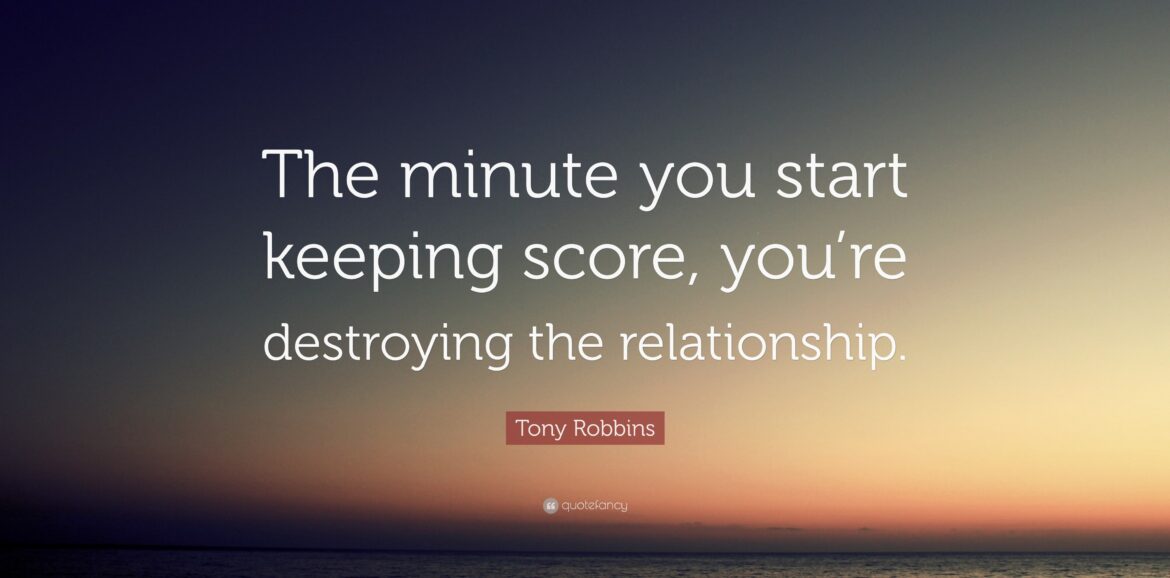
Do any of those sound familiar? There are a million more variations. It’s called score keeping. Not like at a basketball game but in your own home. Or at work.
It’s noticing what you do and the other person doesn’t. It’s keeping track of the other person’s mistakes or the perceived imbalances in the relationship. It’s a running tally of who did or didn’t do what.
Not only is it mentally exhausting, it can lead to resentment or eventually break down of the relationship. Because who likes to be called out all the time for what they didn’t do?
Noticing What’s Not There
I know someone, let’s call her Lady A who does just that – endlessly. When her birthday is coming up (she’s a birthday fanatic!) she makes sure to tell everyone whose card came first, whose came last and whose didn’t come at all.
When she sends out what she considers an important email she makes sure to point out, “for those of you that responded.” Or “for those of you that didn’t.”
I don’t know about you but if it were pointed out to me that I didn’t respond to something that wasn’t obligatory, it makes me not want to respond. Because it’s her. Because she has a history of pointing it out. Because it gets tiring. And most of all – because it’s totally unnecessary!
We’re all adults here.
But most people don’t act that way. Seriously, they don’t. You’d be surprised.
We all do some of the things I talk about on this blog. Because we’re human. It’s when negative behavior becomes chronic that it’s a problem. The one-offs are just that – isolated behavior. But when people do negative things all the time, like scorekeeping, fractures appear.
Notice What Is There
To avoid that, be ever mindful of what you say. Pay close attention to what others are really saying. That avoids 90% of communication errors. But since we’re not perfect, we have to do the best that we can do.
Start with score keeping. Resist the temptation to point out what your partner or co-worker isn’t doing. Instead, openly and honestly discuss your needs. Go with the reframe. “I’m always the one who has to do X” can become, “I’ve been working really hard lately. I know we’ve both been doing things around here but how about I do X and you do Y? That will help spread the load evenly.”
That takes the pressure off of you and invites, not scolds the other person into assisting. People are more likely to help when asked nicely, not when they are shamed or blamed. When someone no longer feels like it’s a competition, they’re much more likely to roll up their sleeves and dig in.
Because score keeping can feel like a competition. “I always do this so why should I help you do that?” Yeah, that made me want to step up. Not. Forget what you’ve always done and man up and help them when they need it. That goes a long way. And you’ll be surprised how it can be reciprocated. Your “opponent” will become your team player.
Infuse some gratitude. Without gratitude it feels like every action becomes transactional. Like you’re doing something just to get something. Then it can become dread like you have to do it. No one wants that. Yeah, you cooked dinner and they didn’t take out the trash. Really, so what? Be grateful they took out the trash or else that’s two chores for you! Stop noticing what they didn’t do and be thankful when they do something. I bet they do more than you give them credit for. If not, then it’s time to have a talk, don’t let it come out sideways like this.
Or else it breeds resentment.
It’s What’s Not Being Said
You might start feeling like you do everything and they might feel the same way. Or they become resentful that you’re always pointing out their shortcomings. Or vice versa. And that’s when the little things start to stack up on top of each other. Before you know it one or both of you are justifying why this relationship stinks and could start fantasizing about wanting out.
That’s normal to feel that way, but the more mature thing to do is discuss it before it gets there. One reason it gets to this point are unsaid expectations. Humans are notorious for thinking things should go a certain way. But life often doesn’t work that way. If you’re thinking you should do A and your partner is thinking you should do B how can you know that? Communication.
Unmet needs and expectations create more conflicts than anything because they aren’t communicated. We’re not mind readers! It’s important to tell our partner, our co-worker, our mom, whoever, what we want or expect. Otherwise, how can they know? How can they give it to us?
Love Language Differences
Remember the Love Language phenomenon that came out in the 90s? The concept is based on how we express our needs and gratitude differently. Some people express a thank you or love by doing something for someone. Others do it by buying gifts. When the two styles don’t match up, it can lead to hurt, anger, disappointment and conflict. Because the signs aren’t being read properly.
If you’re expecting your partner to constantly hold your hand and he never does, pointing it out to him and telling him how often he doesn’t do it won’t make him want to do it. Instead, ask nicely for it on occasion. But if that’s not his love language, forcing him to do it would be like forcing you to go out and buy expensive gifts if that’s not your thing.
Start noticing how your partner expresses their love. Then step back and appreciate it versus criticizing them because they can’t do it the way you do. People are wired differently. Do your best to accept that versus noticing when they don’t do what you want the way you want. That can reduce a lot of score keeping tendencies.
If someone is insecure, they may resort to score keeping more. That can be annoying to the recipient. See it for what it is. Like Lady A who needs all the accolades and when they don’t come in, she has to point it out. She needs the accolades around her birthday to know that she is loved. She is loved. It’s just that not everyone expresses their love for her in that way.
She fails to see it, so she stays wrapped up in her little score keeping world totally oblivious to the fact that she’s breeding more resentment along the way. By demanding compliance in a back-handed way, she’s greatly reducing her chances of getting it. And doesn’t see it. She gets hurt that she’s not getting what she wants, others build up resentment for being called out. It’s a lose-lose proposition.
It’s fine to see inequity, it just doesn’t need to be pointed out all of the time. And when it does, do it with kindness, love and appreciation.
You know what they say, “You catch more bees with honey!” I prefer that one to, “It’s like flies on sh**” because that one points out what stinks! And no one likes to be pointed out for their stink – or in this case perceived shortcomings. I’m going with the honey! How about you?